Tuesday, January 22, 2013

Life in Range of North Korean Artillery

North Korea is effectively the biggest mafia in the world. Though described by the Western media as the last Stalinist dictatorship on earth, the reality of what goes on inside North Korea is much more complex. 

The latest North Korean constitution omits all references to the word "communism." Instead, Juche, the philosophy developed around Kim Il-Sung, and Songun, the philosophy developed aroung Kim Jong-Il, are the official state ideology. Kim Il-Sung, the country's founder, passed away in 1994, but he is eternally recognized as the president of NK. It's a serious faux pas for a North Korean to utter the name of their leader without also mentioning their leader's title. A gulag may await anyone who simply says "Kim Il-Sung" instead of "President Kim Il-Sung."

His recently deceased son, Kim Jong-Il, must also be treated with rigid deference: dear leader, or general secretary. There are no higher offices in North Korea, meaning that Kim Jong-Un, the grandson and anointed supreme leader, must give himself the lower position of first secretary.

The level of obedience and loyalty that must be displayed to the leader surpasses that of most fictional exaggerations of any mafia don. When a North Korean ship caught fire in November 2009, the sailors who were most rewarded for bravery were the ones who sacrificed themselves upon portraits of the dear leader, lest it be ruined by fire. Life has an irrational value in North Korea. 

It was after the fall of the Soviet Union and the death of Kim Il-Sung that North Korea sank into poverty. Kim Jong-il, his son, was a hermit, who spoke publicly only once, in 1992, uttering merely a few words: "Glory to the heroic soldiers of the Korean People's Army!" Kim Jong-Il didn't have the charisma to be a statesman like his father, but he was a far more cunning survivor. To sustain the regime at any cost, Kim Jong-il established Office 39. Office 39 is tasked with providing black money for the regime. 

The Secret Service describes North Korea as the biggest counterfeiter of US currency on earth. Likewise, NK is a manufacturer of meth -- with use rampant in the country -- not to also mention that the country is an exporter of banned weapons to other renegade regimes. 

Though seemingly a failed state, the power of NK comes mostly from its proximity to Seoul. South Korea's capital has 25 million people and is one of the world's most important mega-cities. Along the border, less than 50 kilometers away, North Korea maintains over 5,000 pieces of artillery, with strategic targets already pinpointed for destruction. NK could within a matter of two hours level nearly all of the important seats of government, media, education, technology, and transportation in Seoul. 

The very existence of NK is much owed to blackmail, to the fear that their national infrastructure is so barren that leveling their country would mean nothing to them. The latest North Korean rocket -- that put a satellite in orbit -- ran on red fuming nitric acid, a fuel used in scud-missiles by the Soviet Union. And indeed, after witnessing the fall of Saddam Hussein's arsenal at the hands of the US, NK knows that all of its Soviet-era equipment (tanks, ships, aircraft, etc.) is obsolete.

The North's only hope for preventing an attempt to destabilize their country is the fear of asymmetrical warfare: 70,000 special forces, chemical and biological weapons, infiltration tunnels, and the good fortune of their mortal enemy, the South, having built all its eggs near their basket.

The funniest thing for me, however, is that while in South Korea, I was not at all afraid. Most South Koreans rarely even think or talk about the North. When Kim Jong-Il started bombing Yeongpyeong Island, my students remained largely unfazed. One rising college freshman told me, "you're going to die anyway, so why worry?" to large class approval. 

I learned from my student that people in the US were more afraid of the North than the very people who would receive the first blow. That day, CNN and other news channels in the US made it seem as if the apocalypse had just begun, with the Four Horseman having made their first appearance in Korea. In the South, however, my life continued largely unaffected, and I began further shifting away from the American culture of fear.

Life in Range of North Korean Artillery

North Korea is effectively the biggest mafia in the world. Though described by the Western media as the last Stalinist dictatorship on earth, the reality of what goes on inside North Korea is much more complex. 

The latest North Korean constitution omits all references to the word "communism." Instead, Juche, the philosophy developed around Kim Il-Sung, and Songun, the philosophy developed aroung Kim Jong-Il, are the official state ideology. Kim Il-Sung, the country's founder, passed away in 1994, but he is eternally recognized as the president of NK. It's a serious faux pas for a North Korean to utter the name of their leader without also mentioning their leader's title. A gulag may await anyone who simply says "Kim Il-Sung" instead of "President Kim Il-Sung."

His recently deceased son, Kim Jong-Il, must also be treated with rigid deference: dear leader, or general secretary. There are no higher offices in North Korea, meaning that Kim Jong-Un, the grandson and anointed supreme leader, must give himself the lower position of first secretary.

The level of obedience and loyalty that must be displayed to the leader surpasses that of most fictional exaggerations of any mafia don. When a North Korean ship caught fire in November 2009, the sailors who were most rewarded for bravery were the ones who sacrificed themselves upon portraits of the dear leader, lest it be ruined by fire. Life has an irrational value in North Korea. 

It was after the fall of the Soviet Union and the death of Kim Il-Sung that North Korea sank into poverty. Kim Jong-il, his son, was a hermit, who spoke publicly only once, in 1992, uttering merely a few words: "Glory to the heroic soldiers of the Korean People's Army!" Kim Jong-Il didn't have the charisma to be a statesman like his father, but he was a far more cunning survivor. To sustain the regime at any cost, Kim Jong-il established Office 39. Office 39 is tasked with providing black money for the regime. 

The Secret Service describes North Korea as the biggest counterfeiter of US currency on earth. Likewise, NK is a manufacturer of meth -- with use rampant in the country -- not to also mention that the country is an exporter of banned weapons to other renegade regimes. 

Though seemingly a failed state, the power of NK comes mostly from its proximity to Seoul. South Korea's capital has 25 million people and is one of the world's most important mega-cities. Along the border, less than 50 kilometers away, North Korea maintains over 5,000 pieces of artillery, with strategic targets already pinpointed for destruction. NK could within a matter of two hours level nearly all of the important seats of government, media, education, technology, and transportation in Seoul. 

The very existence of NK is much owed to blackmail, to the fear that their national infrastructure is so barren that leveling their country would mean nothing to them. The latest North Korean rocket -- that put a satellite in orbit -- ran on red fuming nitric acid, a fuel used in scud-missiles by the Soviet Union. And indeed, after witnessing the fall of Saddam Hussein's arsenal at the hands of the US, NK knows that all of its Soviet-era equipment (tanks, ships, aircraft, etc.) is obsolete.

The North's only hope for preventing an attempt to destabilize their country is the fear of asymmetrical warfare: 70,000 special forces, chemical and biological weapons, infiltration tunnels, and the good fortune of their mortal enemy, the South, having built all its eggs near their basket.

The funniest thing for me, however, is that while in South Korea, I was not at all afraid. Most South Koreans rarely even think or talk about the North. When Kim Jong-Il started bombing Yeongpyeong Island, my students remained largely unfazed. One rising college freshman told me, "you're going to die anyway, so why worry?" to large class approval. 

I learned from my student that people in the US were more afraid of the North than the very people who would receive the first blow. That day, CNN and other news channels in the US made it seem as if the apocalypse had just begun, with the Four Horseman having made their first appearance in Korea. In the South, however, my life continued largely unaffected, and I began further shifting away from the American culture of fear.

Monday, January 21, 2013

The US Empire of Bases

On a daily basis, over 30 flights come-and-go from Camp Lemmonnier in Djbouti. Since the Obama administration upped the use of drones in Yemen and Somalia, air traffic has become problematic for the tiny, impoverished African nation. Though massive by African standards, Camp Lemmonnier represents a relatively new and small addition to the United States' behemoth collection of bases around the world.

According to the Department of Defence, the United States has a total of 668 bases, circling the world in every place but Antarctica. The number 668 is a decrease from the official number of 702 in the year 2003. The fact is, the Pentagon doesn't list the number of bases that it has in Afghanistan in its current report. The total number of US bases is thus a mystery to just about everyone.

The CIA -- which since the advent of the war on terror has morphed beyond its origins as an intelligence gathering operation into a paramilitary force that operates a classified number of drones out of classified number of locations -- has also exploded the number of US installations abroad.

Most Americans that you'd come across could never even begin to imagine just how massive some US bases are. Yongsan US Army Garrison in South Korea has over 20,000 personnel -- bigger than many American towns -- despite the Korean war having ended nearly 60 years ago.

Likewise, Japan has become a vassal states to American military supremacy. Around most military bases, American military police can be seen patrolling establishments frequented by off-duty soldiers. In essence, the US army has powers on the streets of Seoul that would be in America in contravention of the Posse Comitatus act of 1878. Basically, it's illegal for the US army to do in the streets of America what it can casually do in its vassal states. It's ridiculous to presume that a country with a massive, foreign army within is borders is truly free.

Beyond land installations, of which the US just established one in Australia, one could argue that aircraft carriers are in essence floating bases. Bases project power and serve as infiltration units into all levels of a subjugated society. When New Zealand decided that it didn't want nuclear ships in its waters, the US downgraded it status from "ally" to "friend" because the anti-nuclear law effectively banned US nuclear vessels from its territorial waters.

The truth is that no one can truly say how many facilities the United States operates outside of its borders, but it represents the most massive show of shadow force by any empire since the British. The cost to the American taxpayer is also a mystery. In the American Democracy, the citizens are not allowed to know what its armed forces and paramilitary unit (CIA) call home.

The US Empire of Bases

On a daily basis, over 30 flights come-and-go from Camp Lemmonnier in Djbouti. Since the Obama administration upped the use of drones in Yemen and Somalia, air traffic has become problematic for the tiny, impoverished African nation. Though massive by African standards, Camp Lemmonnier represents a relatively new and small addition to the United States' behemoth collection of bases around the world.

According to the Department of Defence, the United States has a total of 668 bases, circling the world in every place but Antarctica. The number 668 is a decrease from the official number of 702 in the year 2003. The fact is, the Pentagon doesn't list the number of bases that it has in Afghanistan in its current report. The total number of US bases is thus a mystery to just about everyone.

The CIA -- which since the advent of the war on terror has morphed beyond its origins as an intelligence gathering operation into a paramilitary force that operates a classified number of drones out of classified number of locations -- has also exploded the number of US installations abroad.

Most Americans that you'd come across could never even begin to imagine just how massive some US bases are. Yongsan US Army Garrison in South Korea has over 20,000 personnel -- bigger than many American towns -- despite the Korean war having ended nearly 60 years ago.

Likewise, Japan has become a vassal states to American military supremacy. Around most military bases, American military police can be seen patrolling establishments frequented by off-duty soldiers. In essence, the US army has powers on the streets of Seoul that would be in America in contravention of the Posse Comitatus act of 1878. Basically, it's illegal for the US army to do in the streets of America what it can casually do in its vassal states. It's ridiculous to presume that a country with a massive, foreign army within is borders is truly free.

Beyond land installations, of which the US just established one in Australia, one could argue that aircraft carriers are in essence floating bases. Bases project power and serve as infiltration units into all levels of a subjugated society. When New Zealand decided that it didn't want nuclear ships in its waters, the US downgraded it status from "ally" to "friend" because the anti-nuclear law effectively banned US nuclear vessels from its territorial waters.

The truth is that no one can truly say how many facilities the United States operates outside of its borders, but it represents the most massive show of shadow force by any empire since the British. The cost to the American taxpayer is also a mystery. In the American Democracy, the citizens are not allowed to know what its armed forces and paramilitary unit (CIA) call home.

Sunday, January 20, 2013

How I Met my Current Girlfriend

It was a typical summer afternoon and I was wandering around the Red Light District looking for a place to innocently wet my whistle. I was still a relative newcomer to the Amsterdam scene and so I generally just stumbled around letting destiny take me where it desired. Eventually I cut pass Oudezijds Achterburgwal -- Amsterdam's answer to Korea's Hooker Hill -- into Chinatown, and over to Zeedijk street. 

I could smell the booze and drunkenness from down the street and immediately made my way there. I quickly noticed that this wasn't your typical street party. There was booze being served on the street and I ordered a Heineken in the hope that it would help me understand just exactly what kind of street party I had stumbled into.

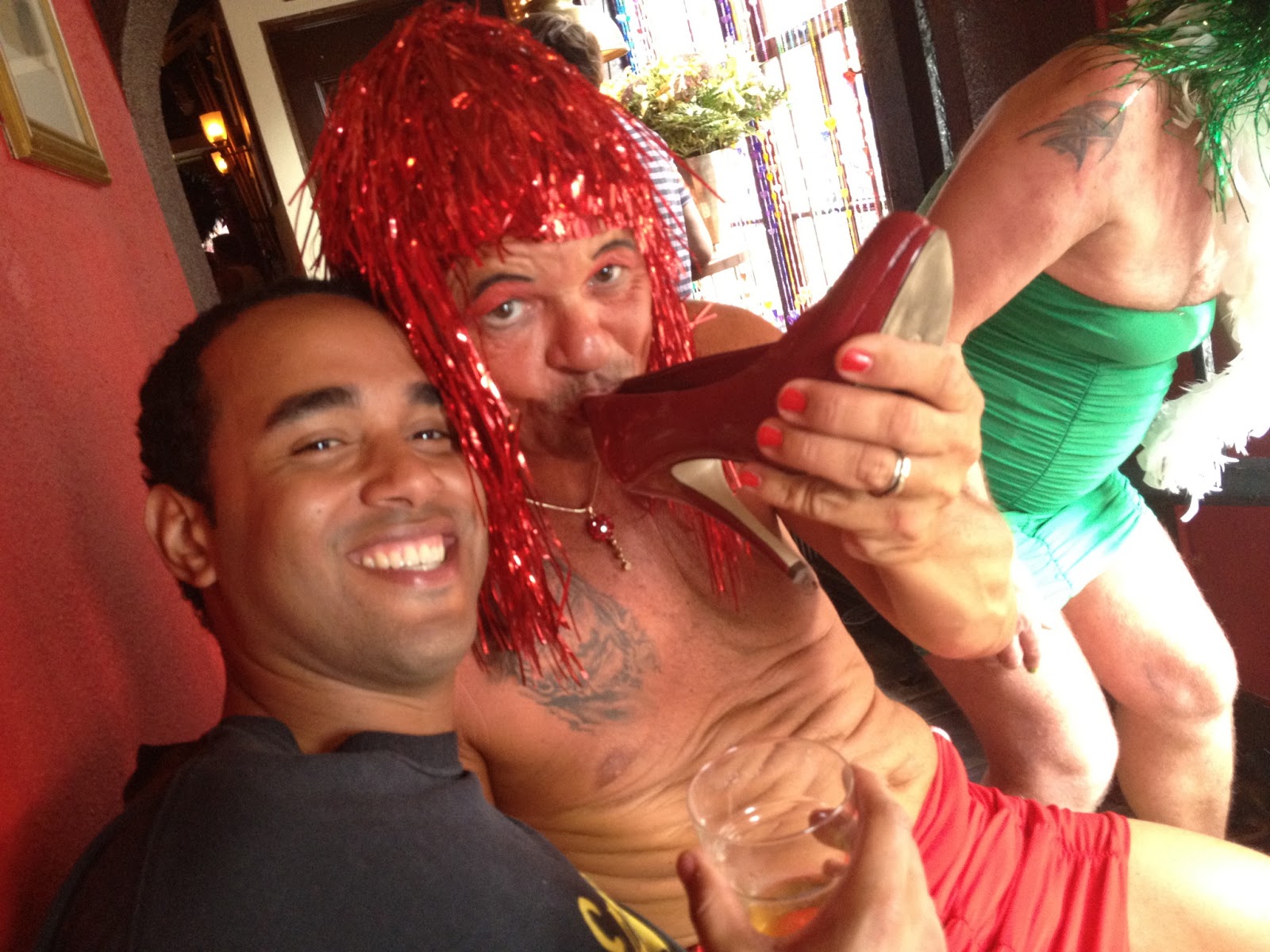
Around me were drag queens in colors so bright my eyes could barely process them without feeling that burning sensation that comes from staring directly at the sun. Even as I ordered my first beer, a chunky grandmother grabbed my ass and made a licking motion in my direction, the tip of her tongue flickering down and away from her fake mustache. 

The beer was pricey, and I noticed a liquor store. As I made my way into the liquor store, I came across a stunning six-foot blonde hanging out with her friends.  I may be a liberal, open-minded guy, but at the risk of sounding inconsiderate, I have to confess that I'm simply not attracted to 7-foot-tall Dutch guys in flashy dresses and heels. As the closest thing to a straight guy in that festival, I knew I had an advantage.

So I get to the door of the liquor store and I glance over at her left hand, realizing that my target had a wedding ring. This is Amsterdam, where people don't waste time or mince words, so I quickly asked her, "Is that your wedding ring?"
"I'm not married," she replied, and I snapped back, "Oh yea? Well, let me get another beer and I'll be right back."

After almost getting into a fight with the Surinamese worker inside the liquor store, I calmly made my way out, beers in hands. Joana and I asked each other the usual questions and I learned she was also vegan and unemployed. "We're going to be spending a lot of time together if the pussy is good," I thought to myself. 

I would later learn that the vibe I gave her was that it'd be a one-night stand, but it's not everyday that I meet a vegan woman with as much free time as me. I'm surprised she didn't factor that in as we made out in the middle of the drag street festival while gay guys giggled and told us, "It's unnatural!"

We kept kissing and walked into one of the gay bars just to the right of the canal. We molested each other on the way to the back of the bar, and into a quiet nook overlooking the canal parallel to Warmoestraat. As we kissed, a senior citizen in drag blessed our union by drinking from his "holy heel."

Once he started drinking from his shoe, Joanna and I knew we both had drunk enough, and I asked, "Your place or mine?"
I was hoping she'd say hers since I was sleeping on a leaky air mattress with nothing but a radio for entertainment. 
"Let's go to mine," she suggested and I breathed a sign of relief on the way to grab the tram. Eventually we got to her apartment and sat on the balcony.
"So, you don't look 34," she uttered.
"I'm 24," I replied, not caring that she'd overheard the fact that I was much younger. When it comes to love, I've realized that it has no age. I've dated women in their 30s who had the maturity level of a 15-year-old school girl.

But our age difference didn't matter and we jumped in bed, having sex twice that night and twice the next morning. I knew the next morning I'd found someone with whom I share a wild chemistry and spirit of adventure.

What we like the most, however, is when we meet other couples and eventually they ask us how we met.
"We met at Day of Hearts; it's a drag street festival on the Zeedijk." 
Immediately people begin to wonder, and can't help but ask, "so, were you guys in drag?"

We laugh and always reply, "no, but we're working on gender-bending next year."